
Getting Export-Ready Before the First Call: A Fragrance File
Most first calls about an export fragrance order fail for a boring reason rather than a difficult one. The brand has not written down what it wants to ship, where it is going, how often it will move, or who will receive it, so the conversation becomes a general discussion about possibilities and ends without a price, a lead time or a next step. The fix is not more knowledge. It is a single page of decisions made before the call.
Key takeaways
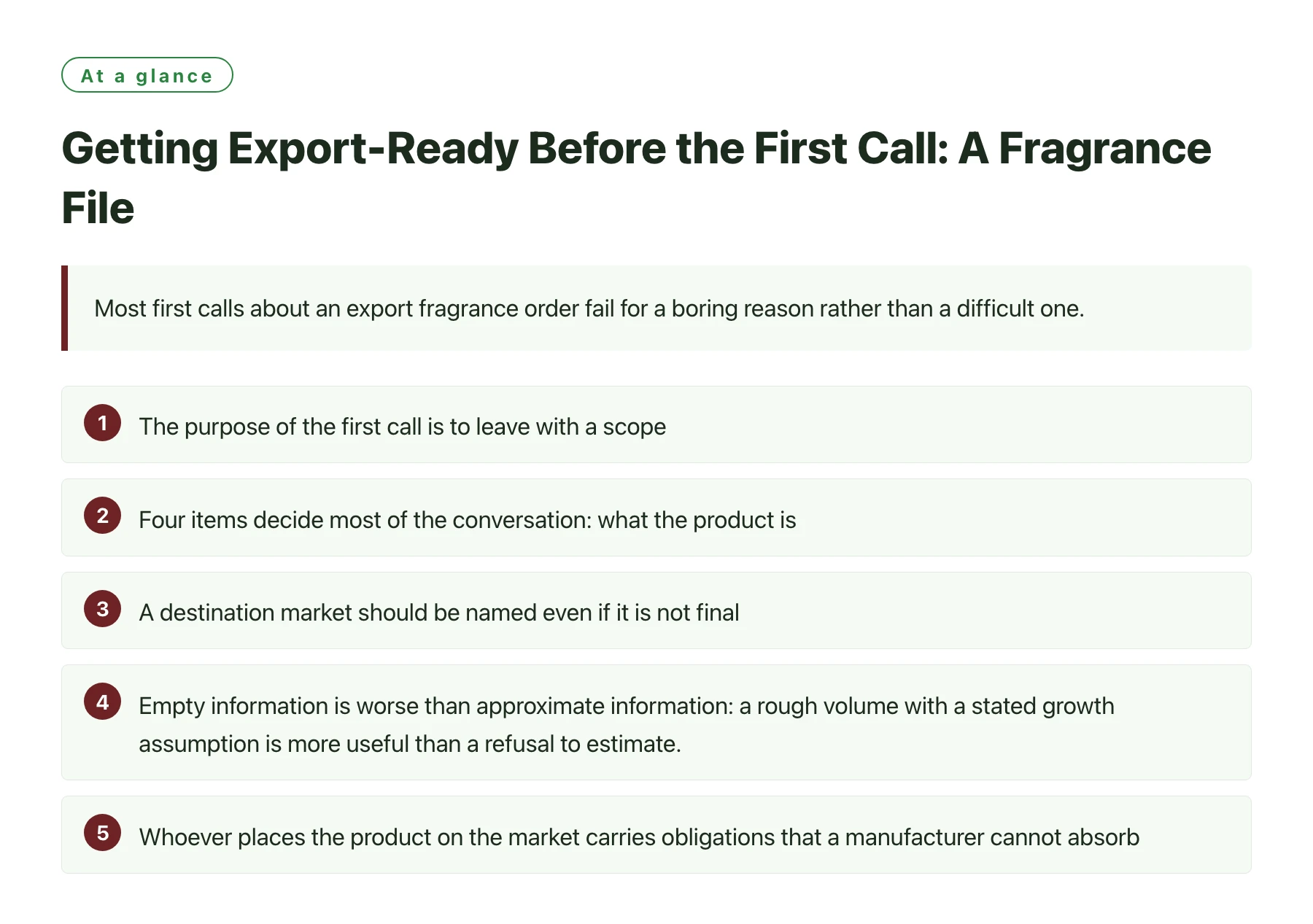
- The purpose of the first call is to leave with a scope, an indicative price and a next step, which requires decisions rather than questions.
- Four items decide most of the conversation: what the product is, where it is sold, how often it ships, and who imports it.
- A destination market should be named even if it is not final, because market rules shape labelling and testing long before they shape price [1].
- Empty information is worse than approximate information: a rough volume with a stated growth assumption is more useful than a refusal to estimate.
- Whoever places the product on the market carries obligations that a manufacturer cannot absorb, so the importer question belongs in the first ten minutes [2].
- The call should end with a written summary sent by the brand, because the summary becomes the brief if the relationship continues.
A manufacturer's sales team hears the same call several times a day. What separates the calls that produce a quotation from the calls that produce a brochure is rarely the size of the brand. It is whether the person on the other end has decided what they want.
That is genuinely good news for a first-time founder, because the decisions are all within reach and can be made alone, at a desk, with no specialist knowledge. The hard part is knowing which decisions matter to an export conversation, since export is where a fragrance project stops being about scent and starts being about goods, documents and destinations.
This is the file worth having on the screen before dialling. None of it requires certainty. All of it requires a position.
Why the first call usually goes badly
A call without a file tends to follow a predictable shape. The brand asks what is possible, the supplier describes a wide range of services, both sides enjoy the conversation, and nothing is committed. A week later the brand realises it still does not know whether the project is viable at its volume, and the supplier has moved on to a call where somebody knew.
The opposite failure is just as common. A brand arrives with a fully specified product, a fixed price expectation and no flexibility, which forces the supplier into a yes or no rather than a discussion about how to reach the target. The productive middle is a small number of firm decisions surrounded by clearly labelled assumptions.
The file to assemble before dialling
- The product definition, at whatever resolution you haveFormat, fill size, approximate concentration, pack type and whether artwork exists. A sketch and a written description is enough; a manufactured prototype is not required.
- The destination market, namedEven a tentative first market is better than everywhere. Destination decides labelling language, ingredient restrictions and testing scope, and those are answered by the market's own rules rather than by preference [1].
- The cadence and the volumeFirst order quantity, expected monthly or quarterly run rate, and the assumption behind the growth. Subscription brands live or die on cadence, so say how the box ships rather than only how much liquid it contains.
- The importer positionWhether the brand has a local entity, plans to use a service provider, or expects the supplier to ship to a warehouse. Placing a cosmetic product on a market carries obligations that sit with the brand [2].
- What testing already exists and what does notAny stability or compatibility work done to date, and the tests the brand expects the supplier to commission, so the two lists can be compared rather than assumed.
- The date the goods are neededA calendar date, not a horizon. It is the single most useful number in the conversation because it converts every other answer into a schedule or a refusal.
What to ask on the call, and in what order
Ask about scope before price. A quote for filling without packaging is not comparable to a quote that includes bottles, cartons and decoration, and comparing the two numbers produces a misleading conclusion about which supplier is cheaper.
Ask how the goods have been classified before, and which destinations have caused paperwork problems. A supplier that exports regularly will answer with specifics about markets rather than with general reassurance, and that answer is a useful preview of how much export administration the brand will be carrying itself.
Ask what the sample-to-production handover looks like, and what the supplier needs at each stage. This is the point where from formula to finished bottle from formula to finished bottle stops being a diagram and becomes a list of decisions with owners.
Then ask about volume flexibility, because subscription demand is not flat. A supplier that can describe how it handles a month at half volume and a month at double is easier to plan with than one that quotes a single number and treats any change as a new negotiation.
What the manufacturer will want from you, and why
| What they ask for | Why it decides something | What a good answer looks like |
|---|---|---|
| Target market and channel | It fixes the labelling, testing and documentation scope before any price is built | One primary market, a named channel and a stated fallback |
| Fill volume and pack | It drives material cost, filling time and freight weight more than the formula does | A preliminary specification with a tolerance, plus what is still open |
| Order quantity and cadence | It determines whether the project clears a minimum and how the line is scheduled | A first order figure and a monthly run rate with the assumption behind it |
| Artwork and packaging ownership | It decides how much of the project sits with the supplier and how much with the brand | A statement of what exists, what is designed, and who holds the files |
| Payment and delivery structure | It shapes scheduling priority as much as it shapes cash flow | A deposit and balance proposal with the trigger for each |
Every one of these is answerable before a call. Approximate answers are fine; absent answers push the conversation back a week.
Choosing whom to call in the first place
The file also makes the shortlist easier. A brand that knows it needs small monthly runs should be talking to a fragrance manufacturer in Guangzhou a fragrance manufacturer in Guangzhou whose export routine matches that pattern, rather than to whichever supplier answered first.
Two quick filters are worth applying before the call. First, whether OEM perfume production in Guangzhou OEM perfume production in Guangzhou is presented with concrete scope rather than with a service list, because concrete scope is what makes a quotation possible. Second, whether the supplier can name the export destinations it works with most often, since that answer predicts how much of the customs work will land on the brand's desk.
A supplier that handles fragrance R&D and production a factory that handles fragrance R&D and production in one place can absorb more of the project, which matters most for a small team. A supplier that coordinates rather than manufactures can also work well, provided the brand knows that it is buying coordination and is prepared to manage more handovers.
Send a one-page summary within an hour of the call. Scope, assumptions, price indication, next step and date. It costs ten minutes and it converts a pleasant conversation into a project.
Sources
- European Commission: Cosmetic Products — Specific Topics —— EU pages covering specific cosmetics topics such as product claims, nanomaterials and animal-testing rules.
- Health Canada: Cosmetic Safety —— Health Canada's cosmetics pages, covering cosmetic notification, the ingredient hotlist and safety requirements for cosmetics sold in Canada.
Frequently asked questions
How much do I need to know before the first call?
Less than most founders assume. A product concept, a target market, a rough volume, a cadence and a date are enough to have a productive conversation. Technical detail can be developed with the supplier afterwards.
Should I get a price on the first call?
An indicative range is realistic if the scope is defined. A firm quote is not, because price depends on pack, volume, decoration and destination, and those are usually still open. Ask what information would turn the range into a firm number.
What if I do not know which market I will sell in yet?
Name the most likely one and say it is provisional. Market rules shape labelling and testing requirements early, and a provisional answer lets the supplier plan while leaving room to change before artwork is finalised.
Do I need a company entity before ordering?
Not necessarily before enquiring, but the entity question affects who can act as importer and who carries the obligations that come with placing the product on the market. It is worth knowing your options before the topic arises rather than during a shipment.
How many suppliers should I call?
Three is a workable number for comparison, provided the same file is used for each call. Comparing conversations held on different assumptions is the most common way a brand ends up with a shortlist that cannot be compared.